Bowing Down With The Oxen
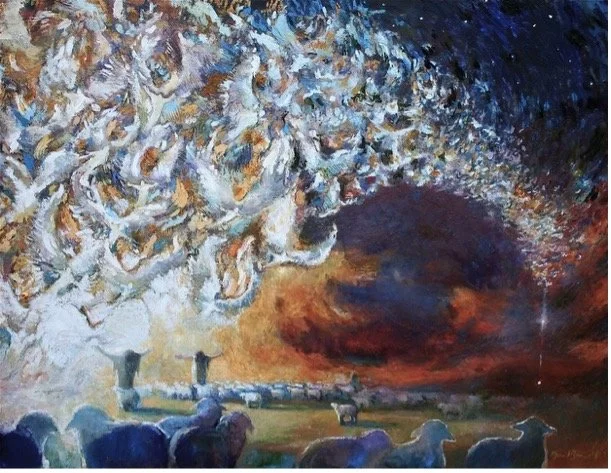
Daniel Bonnel, Seeing Shepherds
On this glorious day before Christmas, in a moment of deep pondering and expectation, I’m sending along a poem that has intrigued and delighted me since I first encountered it many years ago. It’s a Christmas poem, written by Thomas Hardy in the early years of the twentieth century, called “The Oxen” (1915). You may had encountered it too.
I love the poem’s childlike imagination at play as the oxen, in that “strawy pen” of the manger, kneel down to worship the baby Jesus. You might be thinking back when the stories of Christmas were read to you as a child, accompanied with all the embellishments parents and teachers were prone to include. It was all so delightful. We felt there was something utterly new taking place. The whole world is noticing this moment. We were filled with wonder.
Hardy caught some of this wonder, to be sure. But, as with all good poems, there is a lot at play here. Read the whole poem first and then we’ll talk a bit:
Christmas Eve, and twelve of the clock.
“Now they are all on their knees,”
An elder said as we sat in a flock
By the embers in hearthside ease.
We pictured the meek mild creatures where
They dwelt in their strawy pen,
Nor did it occur to one of us there
To doubt they were kneeling then.
So fair a fancy few would weave
In these years! Yet, I feel,
If someone said on Christmas Eve,
“Come; see the oxen kneel,
“In the lonely barton by yonder coomb
Our childhood used to know,”
I should go with him in the gloom,
Hoping it might be so.
There was a time we could still be swept up in wonder and awe and worship. A time when we could still believe what our elders are telling us. Something miraculous is going on, something special, something new. The oxen knew it. In those days we had no doubt.
But notice that Hardy is opening the doors to enter into our modern consciousness where we can’t resist our skepticism. We are on the borderline here crossing over into a narrative of denial where all things are called into question. The birth of this holy child? The kneeling of the oxen? Shepherds and angels singing? Hardy projects forward to a new culture bereft of such wonder and awe.
So we end the poem with a kind of haunting nostalgia, a longing actually, so characteristic of our modern age. We’ve got to be skeptical of kneeling oxen, but really, the poet seems to say, don’t we still long for a time when we could believe such a thing? Don’t we long for the wonder of it all. I find that “hoping it might be so” so very frail up against the forces that seek to dismantle the sacred order of our civilization.
But we may sing from a radically different poem on Christmas Eve. We might enter an entirely different narrative through the words of the great Charles Wesley and his marvelous hymn of 1739. Notice the second verse:
2 Christ, by highest heaven adored,
Christ, the everlasting Lord,
late in time behold him come,
offspring of the Virgin's womb:
veiled in flesh the Godhead see;
hail th'incarnate Deity,
pleased with us in flesh to dwell,
Jesus, our Immanuel.
Refrain:
Hark! the herald angels sing,
"Glory to the newborn King"
Can we believe it? Can we sing it this Christmas Eve in our hour of gloom? How can we possibly not participate in this joyous choir? “Pleased with us in flesh to dwell, / Jesus, our Immanuel”—this is the answer to our longing, isn’t it? This is the answer to restoring our lost sacred order. More than ever I want to join the angelic hosts, this Christmas Eve, and beyond. I want to bow down and kneel with the oxen. No more of this weak “hoping it might be so.” I want to belt it out: “Glory to the newborn King.”
May it be so, Lord, this Christmas Eve! Come, Lord Jesus! Let us bow down with the oxen before this baby who changes everything.