Me Too!
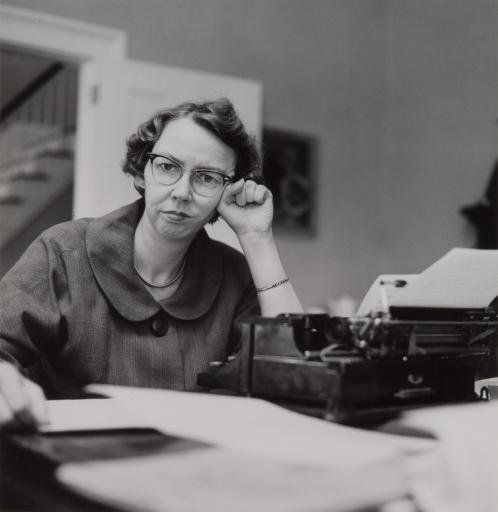
Flannery O’Connor, Spencer Museum Of Art
In January 1947, the great Southern American writer Flannery O’Connor, while still a young student, began keeping a prayer journal, really a small collection of prayers. I’ve been rereading this lovely little volume, A Prayer Journal, in my own journey on prayer. She was twenty-one years old when she began the writing. She was a student at the famous Iowa Writers’ Workshop. We learn from these youthful prayers how passionately she wants to become a great writer. Will God help show her the way, she asks? We also learn that she wants to love God as fully as she can, a desire not separate from her desires about vocation. Can these two deep desires live side by side, she ponders?
Please help me, Lord, she pleads, “to get down under things and find where You are.” That’s pulling the two desires together, isn’t it? Try reading, hopefully rereading, one of her stunning stories to see how brilliantly she accomplishes getting “down under things.” And notice how she finds God down there even in the darkest of her stories. That’s the way I want to live. That’s the way I would love to write.
By the way this book of prayers is edited by some professor who just can’t handle all the God talk. Amazingly he actually puts all the references to God and Christ and the Lord in quotation marks, as if, I guess, they can’t be real, or at least they don’t really exist for we savvy secularists. He wants Flannery not to yearn for God as much as she does. Skip his introduction.
In one line of her prayers, O’Conner wonders: “I do not know You God because I am in the way. Please help me to push myself aside.” I’ve been mulling this line for days. I think I know this need to push myself aside so I can pray more fully.
When I sit down in my prayer chair, in that early morning solitude, do I persist in checking my phone first? I do. There is Augustine’s distorted loves again. Can I really calm down all that incessant chatter of my mind? Sometimes it might be the mind inquiring whether God is truly present, those intellectual inquiries. Sometimes it might be the hurt I’ve felt from someone the evening before. Sometimes it might be those powerful ego-needs to be praised. It’s hard to push myself aside, but I find it more necessary all the time, if I really want to pray.
As I pondered all of this, something new occurred to me. Maybe it’s the preaching our pastor is doing these days on Genesis. As I approach this time of prayer, I need to come as a child of God? In his image, I am told. That’s who I am, you know? I don’t have to measure myself by some standard God is not even thinking about. He is not as tuned into the ego-chatter as I am.
Just rest easy, he is saying. Just welcome me into your little space. Just remember that I bring peace and joy and grace to my children. Those other things are distractions. All that chatter is focusing on yourself. You’ve got to push that part of you aside and focus on my grace and love.
The ancient monastics talk a lot about this pushing the anxious self aside. They certainly know as much about anxiety as we do. But not just monastics, of course. Listen to this favorite hymn?
Turn your eyes upon Jesus
Look full in His wonderful face
And the things of earth will grow strangely dim
In the light of His glory and grace.
This sounds like the ancient Jesus prayer: “Lord Jesus Christ, have mercy on me.” This simple prayer has been cited for centuries by millions of people. When you are a child of God, made in his image, as O’Connor most surely was, this is precisely how you want to pray. Put your phone away for the first precious hour of the day. Clear out all the distractions that are actually about you and not about God. And then turn, yes, turn your eyes upon Jesus. Look into that wonderful face. Soak in all that glory and grace he has to offer. This is the kind of prayer Flannery O’Connor was searching for. Me too!