So Much Depends
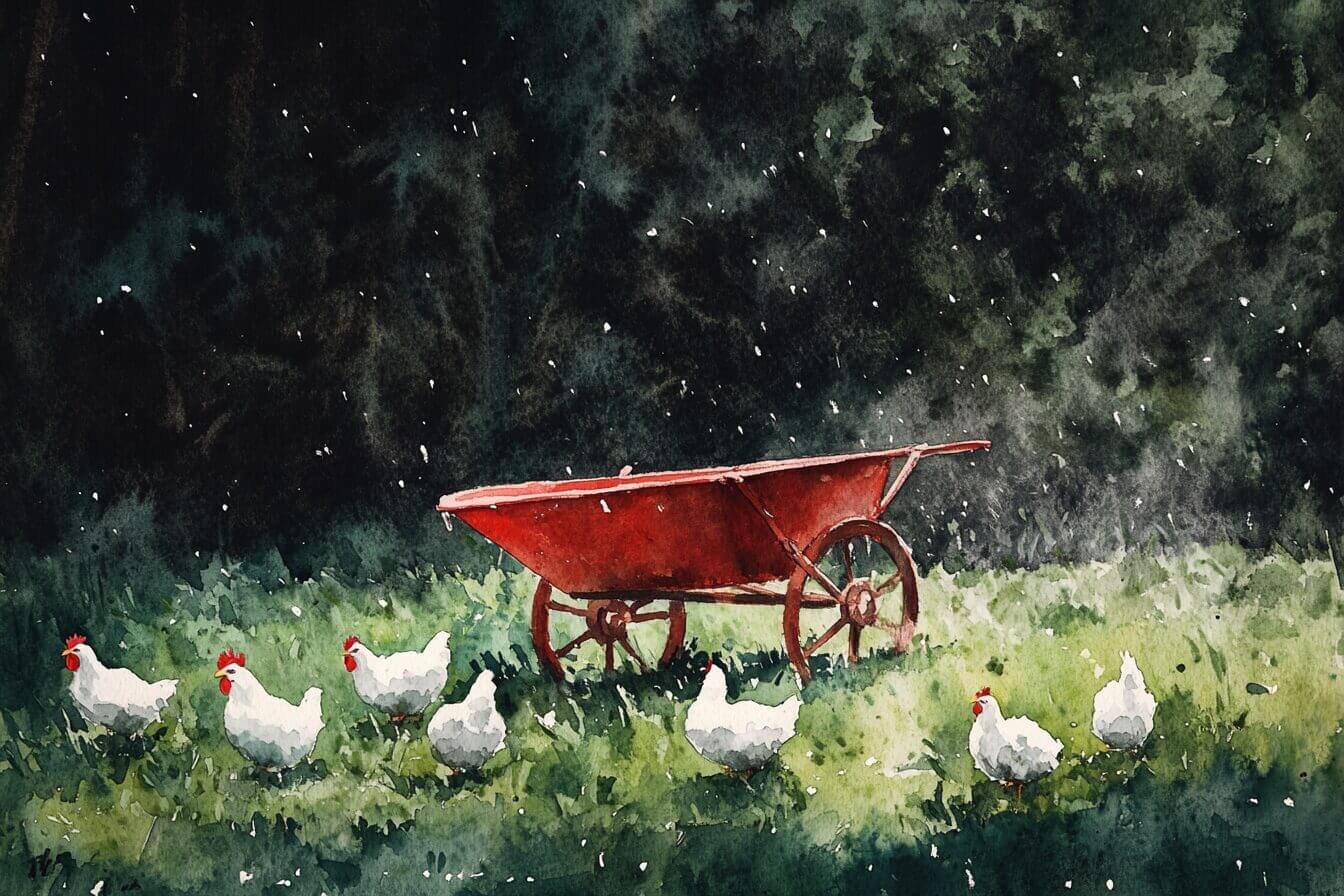
The Red Wheelbarrow
Let’s take a little different angle today. How about if we turn to a few good poets? Let me explain. I am trying to see things more clearly these days. I feel enveloped by fog, too many things to handle, too much uncertainty, too much anxiety all around. Maybe these poets can help me notice the little things. Maybe that’s the way to cut through some of this fog. Maybe this is part of God’s plan from the beginning.
I am reminded of a poem I have taught so many times, William Carlos Williams’ “The Red Wheelbarrow,” written in what was certainly a tumultuous year, 1923:
so much depends
upona red wheel
barrowglazed with rain
waterbeside the white
chickens
Notice the simplicity, how bright the colors are, red and white, and the centerpiece, the red wheelbarrow, glazed with recent rain. Isn’t that refreshing? Do we usually see things this way? Doesn’t it pierce through the fog for the moment?
Here’s another poem from Williams, “This Is Just To Say,” this one from 1934:
I have eaten
the plums
that were in
the icebox
and which
you were probably
saving
for breakfast
Forgive me
they were delicious
so sweet
and so cold
There may be a number of things that poke at our Christian sensibilities: “What, are you just going to steal someone else’s plums?” And then we hear this sort-of half-hearted plea for forgiveness?
What if the poet actually honors our convictions, to a certain extent, but still wants to enjoy the little things. It’s those plums, “they were delicious / so sweet / and so cold.” Maybe he’s thinking of the Psalmist who encourages us to “taste and see that the LORD is good.” (Psalm 34:8) Taste those little things, for goodness sake.
Here is yet another poem I love so much, Mary Oliver’s “The Summer Day,” from 1990:
Who made the world?
Who made the swan, and the black bear?
Who made the grasshopper?
This grasshopper, I mean--
the one who has flung herself out of the grass,
the one who is eating sugar out of my hand,
who is moving her jaws back and forth instead of up and down--
who is gazing around with her enormous and complicated eyes.
Now she lifts her pale forearms and thoroughly washes her face.
Now she snaps her wings open, and floats away.
I don't know exactly what a prayer is.
I do know how to pay attention, how to fall down
into the grass, how to kneel in the grass,
how to be idle and blessed, how to stroll through the fields,
which is what I have been doing all day.
Tell me, what else should I have done?
Doesn't everything die at last, and too soon?
Tell me, what is it you plan to do
With your one wild and precious life?
Would we ever think “to kneel in the grass” after such an encounter with the little things? It’s like prayer, the poet suggests. I’ve seen a lot of grasshoppers, but I am startled into attention when this grasshopper gazes around with “her enormous and complicated eyes.” This is one of those illuminating moments when we get to pause before the little things God has created.
I love this story, one of my favorite lines from all of Scripture: “The man and his wife heard the sound of the LORD God walking about in the garden at the time of the evening breeze.” (Genesis 3:8) Soon the conversation with the man and his wife will grow very difficult, but for now, God is simply “walking about in the garden at the time of the evening breeze.” Surely he is inviting the man and the woman to walk with him. That’s true for you and me as well.
Slow down. Listen to the birds singing. Notice the colors? The complexities will come soon enough, but for now, just relax, slow down, walk with me, says our gentle God, in the cool of the evening breeze.
Can it be that so much depends upon, well, a red wheelbarrow, glazed with rain water? Or how about those sweet, cold plums, or the grasshopper washing her face? Or maybe we notice, perhaps for the first time, our loving God, just walking along in the cool of the evening, pointing out so many good things in his garden. Oh, look at that. Did you ever see such a thing?