Looking At My Empty Canvas
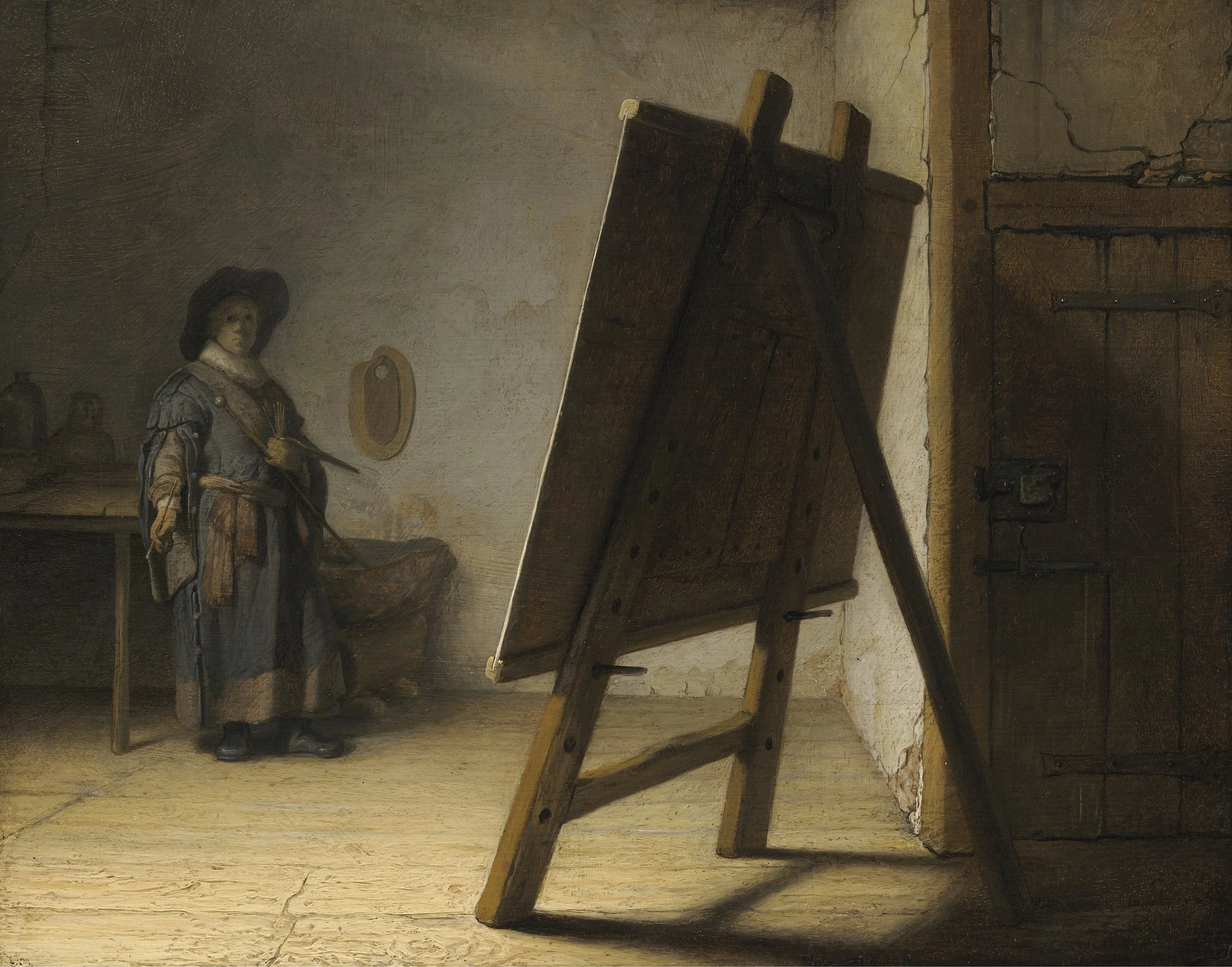
Rembrandt, Artist In His Studio, 1629
Let’s return to Rembrandt one more time. We spent some time last week under the guidance of Rembrandt to learn better how to use our eyes to see into another person, how to see into our own lives as well. The painting I would like to consider today is the Artist In His Studio, painted when Rembrandt was just 26 years old. What is this young man looking for as he peers across the room at his canvas? Whatever it is, I’ve always been intrigued how much energy there is in this room, with this easel poised and waiting. Isn’t that always the way it is when we are face to face with what we love to do?
I suspect the canvas is blank. Perhaps the artist is imagining what kind of painting he would like to create. Or maybe he is contemplating who he is as he launches into the life of an artist. Is he good enough to succeed? He feels called, but what does it really mean to be an artist? He knows for sure how much joy he gets when he is painting. I can only imagine that he is clutching those tools of the artist with affection and wonder and impatience to get going.
But there must have been something even deeper for Rembrandt. I’ve been thinking, as I grow older, what it was, at those deeper levels, that drove my unlikely decision to become a professor of literature? I remember gathering up my tools early on and scrambling to learn how to use them well.
I remember going into my favorite professor to ask if he thought I could teach literature in college. I was not sure I was bright enough. I knew this was not a path taken by anyone in my family. But I knew, and my professor knew, I had that certain passion, a passion for story and poems and the way that words pulled on the mystery at the heart of things.
My calling all began with the word. I began to see that words are the way humans probe into what it means to be human and perhaps how it is we gain access to the wonder of God’s creation. I knew that misused words could badly distort understanding. I was immensely intrigued how the word used well could introduce us the mystery beyond what we regard as real.
It all begins with the word, doesn’t it? In the beginning, we hear, God began to create the
the heavens and the earth. The earth was a vast waste, darkness covered the deep, and the spirit of God hovered over the surface of the water. God said, ‘Let there be light,’ and there was light; and God saw the light was good, and he separated light from darkness. He called the light day, and the darkness night. So evening came, and morning came; it was the first day. Genesis 1:1-5 (REB) (Italics mine.)
There is a lot about words in this extraordinary passage. It became real once he said it into being with a word. And it is good when he says it is good. And then, spectacularly, God brought the man and the woman in and waited to see what they would call all this marvelous creation. What they called each thing, “that would be its name.” Genesis 2:19-20 (REB) (Italics mine.)
Could this be possible? First it is the word bringing everything into being. And then it is the humans naming the things he has created. Could my calling actually have something to do with this naming into being? Could we possibly be co-creators with God in an act of creation? Could this happen at times when I write a good sentence?
I found myself looking across the room at my canvas. This was my painting. This was my music. This could be my poem, my story. This was the way God sought me out and called me to the word and waited to hear what I could say. And then, imagine this, God asked me to share this love for the word with the next generation. That seemed at times nothing short of exhilarating. Something truly wonderful.
And how about you? Your calling will be different, of course, but have you ever thought about that deeper passion that gets you up every morning? And those of you getting a little older, like me, have you thought about those tools you have carried throughout your life. Do you still carry them even now? I’ve been thinking about this lately. I know Rembrandt thought about these things too. Think about it. How have you been looking across the room at your empty canvas? I know I have.